The next productivity frontier: are robotics and automation the future of the construction site?
Key takeaways
Robotics and automation can help construction improve productivity, but only when they support skilled teams rather than replace them.
The biggest opportunity is controlled production, where design, logistics, installation and quality assurance are aligned from the outset.
Clients have a decisive role in scaling automation by standardising demand, making earlier decisions and enabling more repeatable delivery models.
For years, the construction industry’s productivity debate has been dominated by modern methods of construction, digital tools and offsite manufacturing. All remain essential. But the next step change may come from bringing those ideas together with a more advanced generation of automation and robotics.
That does not mean filling construction sites with humanoid robots overnight. In fact, the most useful applications of construction robotics today are often narrower, more practical and less theatrical. The opportunity is not simply to replace manual tasks. It is to create more controlled, measurable and repeatable production systems across design, logistics, installation and verification.
That matters because the case for change is becoming harder to ignore. Mace Construct’s Build Smart, Build Better report found that UK construction productivity is roughly 20% lower today than it was in the 1970s. Between 1997 and 2022, construction productivity improved by about 1%, compared with 182% for manufacturing and 29% for the wider market economy.
Alongside this, the pressure on industry capacity is clear. CITB’s workforce outlook points to a continuing need for construction skills, at a rate of 41,000 extra workers per year. But that should not be read as a simple argument for replacing skilled trades with machines. Many traditional trades, including bricklaying, continue to attract apprentices and remain essential to the industry’s future. The more useful question is how automation can support those skills, take pressure off constrained delivery programmes and allow people to focus on higher-value, safer and more complex work.
Demand is unprecedented. The National Infrastructure and Service Transformation Authority’s latest Infrastructure Pipeline has confirmed £725bn of public infrastructure funding over the next decade. That sits alongside the government’s target to deliver 1.5 million net additional homes in England during this parliament.
The result is a difficult three-pronged equation: deliver more, with greater efficiency, in a labour-constrained environment, while continuing to invest in the craft and site expertise the sector depends on. Robotics and automation will not solve that equation on their own. But they can become a much more important part of the answer where they augment people, improve flow and create more predictable methods of delivery.
Automation is already moving from pilot to practical tool
The industry discourse around robotics has matured. A few years ago, robots on site were often presented as novelties or experiments. Today, the more serious conversation is about where automation can create repeatable value.
A 2026 construction robotics report by Zacua Ventures argues that robotics has moved beyond “pilots, prototypes and promise” in selected workflows, particularly in layout, solar piling, rebar tying and reality capture. The report suggests that the robots which stick are those focused on bounded, high-utilisation tasks that plug into existing workflows, rather than attempting to automate the whole site.
That distinction is important. Construction sites are not factories. They are dynamic, weather-exposed, multi-trade environments where conditions change daily. This makes full automation almost impossible. But many construction activities still contain repeatable, high-risk or data-intensive tasks that are well suited to automation: surveying the same spaces repeatedly, tying thousands of rebar connections, setting out large volumes of points, scanning hazardous areas, monitoring progress, moving materials, fabricating components or checking quality against a digital model.
McKinsey identifies three broad opportunities for automation in construction: automating physical tasks on site, automating modular or factory-based production, and automating design, planning and management processes so that execution becomes more coordinated and efficient. This framing usefully moves the debate away from “robots versus people” and towards a more productive question: where can technology remove friction, reduce risk, improve flow and make skilled teams more effective?
How ‘Dave the Dog’ saves the day: robotics as a safety and data tool
Mace Construct’s own work with automation shows how this shift can happen in practice.
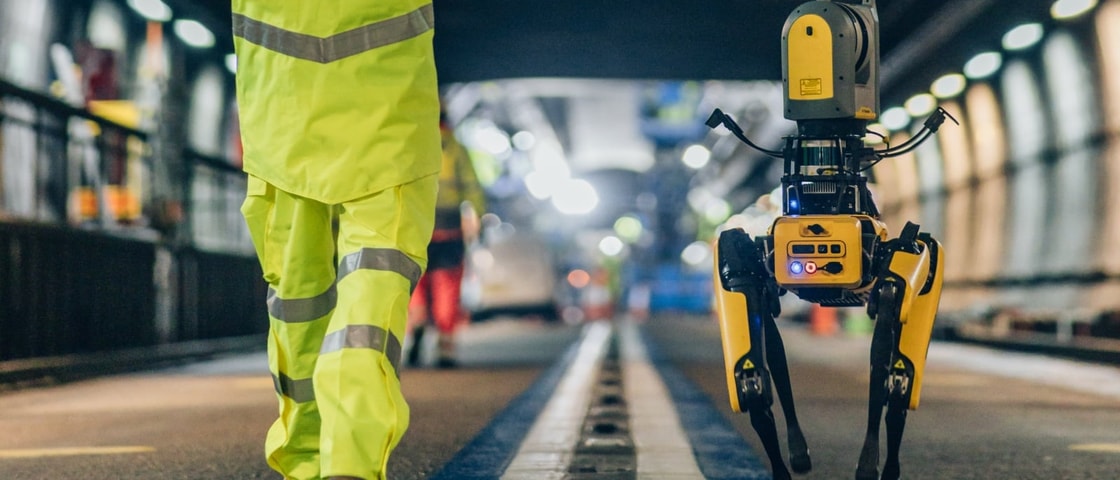
At Heathrow Airport, Mace Construct trialled 'Dave', a Boston Dynamics robotic dog equipped with a Trimble X7 scanner, on the refurbishment of the 1960s cargo tunnel. The robot was used to capture 3D laser scans in a challenging airside environment, supporting construction accuracy, progress tracking and safer access to difficult locations. Mace reported a 50% reduction in setting-out time, with 18,000 bolt fixings due to be set out, and highlighted the ability to create 3D laser scans while reducing workforce exposure to hazardous, dark or slippery areas.
The value is not in the robot itself. The value is in what the robot enables: safer data capture, more accurate as-built information, better comparison against the model and a more reliable digital record of the works.
That is the direction of travel for automation in construction. The most valuable systems will not sit outside the delivery model. They will feed the model. They will collect structured data, inform decisions, reduce rework, improve inspection and help teams understand what is happening on site in close to real time.
This is where robotics becomes more than site equipment. It becomes part of a broader delivery system.
The real prize is controlled production, not isolated automation
The highest-value opportunity is not to automate isolated tasks in an otherwise fragmented process. It is to create controlled production environments where design, procurement, logistics, installation and quality assurance are aligned from the outset.
That means thinking about automation before work reaches site. Robotic fabrication needs components that can be manufactured consistently. Autonomous plant needs predictable sequencing, access and spatial coordination. AI-enabled inspection needs reliable data standards and a clear baseline for comparison. Robotic installation depends on tolerances, interfaces and repeatable details being designed in from the beginning.
This is also where Mace Construct’s construction-to-production thinking becomes relevant. Under a C2P approach, repeatable modules could be assembled in factory conditions using robotic or semi-automated processes, transported to site and then lifted or installed with robotic support. In that model, automation does not remove the need for construction expertise. It changes where and how that expertise is applied, with skilled teams designing, planning, supervising, integrating and assuring a more controlled production process.
Academic research is increasingly pointing in the same direction. A 2025 paper in Buildings argued that construction’s productivity gap is linked to fragmented value streams, inconsistent performance metrics and limited scalability of process improvements. The paper proposes a framework built around standardised, repeatable process steps, real-time sensing, AI-driven monitoring and productivity metrics such as first-time quality, takt time compliance and schedule reliability. Mace Construct’s Build Smart, Build Better report reaches a similar conclusion from project-level evidence, arguing that productivity is not simply a question of working faster on site, but of creating more predictable delivery systems through earlier decisions, better measurement, standardisation, digital coordination and repeatable production principles.
In other words, the technology only works when the production system is ready for it.
Why clients have a decisive role
Contractors and technology providers often lead the visible innovation. But clients may hold the biggest lever.
If every project is procured as a bespoke prototype, the business case for automation becomes harder. Suppliers cannot invest confidently in robotic fabrication if repeatable demand is uncertain. Contractors cannot easily scale automation if designs are changed late, scope is fragmented or logistics are treated as an afterthought. Technology companies cannot prove return on investment if deployments are confined to one-off trials.
By contrast, clients who create repeatable programmes, standardise components, engage delivery partners early and invest in data-rich delivery models can help create the conditions for automation to scale.
That could mean standardising plant rooms, risers, façade modules, bathroom pods, MEP assemblies, temporary works or repeatable elements across portfolios. It could mean using early contractor involvement to test whether designs are buildable by automated or semi-automated methods. It could mean specifying structured data requirements that allow robotic inspection, digital progress tracking and automated quality assurance to work from day one.
The aim should be to make smarter choices earlier, so that more of the project can be delivered with certainty.
Robotics and automation could become one of the most important productivity levers in construction. But the sector should be frank about what that requires.
The future is unlikely to be defined by a single breakthrough machine. It will be defined by whether the industry can create the conditions for automation to work. Technology can make construction faster, safer and more predictable. Technology cannot compensate for late decisions, bespoke designs, fragmented supply chains or poor information flow.
The real productivity shift will come when robotics is treated not as a bolt-on innovation, but as the visible outcome of a better delivery system. Automation will only scale when the industry becomes more repeatable, and construction will only become more repeatable when clients, contractors and supply chains lock in decisions earlier.
Related insights
-
Build Smart, Build Better
Report