Propping up a more sustainable public sector
Circularity through reusable propping at Salisbury Square
The results
85%
of steel propping to form part of a circular economy on future projects
2,519
tCO2e saved
The challenge
Salisbury Square is a large new development from the City of London Corporation. The project includes a new City of London Police HQ, a flagship facility for His Majesty’s Courts and Tribunal Service (HMCTS), grade A commercial spaces and the fitout of a retained listed building. The project is a key step in the City Corporation’s whole life carbon and circular economy targets, aiming to ensure new developments support net zero 2030 aspirations. To support these targets, the Mace team collaborated closely with our supply chain to investigate and implement lower-carbon initiatives and circular principles.
Due to the scale of the project, a high quantity of steel propping was required to support the early stages of the build. Propping can have a significant carbon impact due to the large volume of emissions-intensive steel. It is also typically part of a single-use system, often discarded after completion, increasing overall waste materials. More broadly, our research has shown that whilst 10 million tonnes of recyclable steel is produced in the UK each year, 80% of this is ultimately exported to other markets. Therefore, the need to retain steel within the local construction marketplace is vital.
The approach
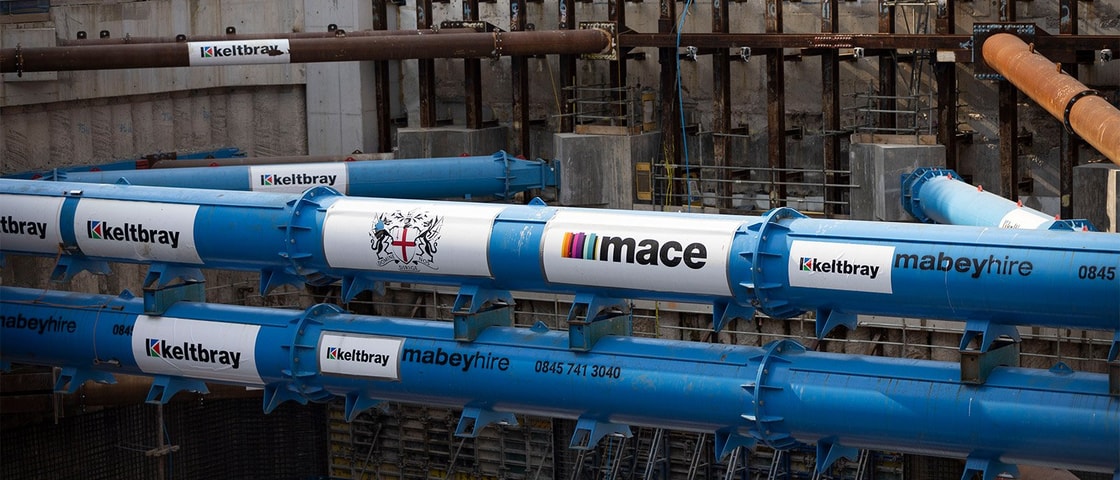
Working with Keltbray, the project team implemented reusable propping systems, allowing the propping to be removed from site and used elsewhere.
Procurement was done with reusability in mind from the outset, with the team including reuse specifications in the tender. Analysing reuse data from the suppliers, Mace identified propping systems with reuse capability; 1/10th for first level propping or ½ for second and third level propping throughout the project lifecycle.
The conclusion
Through this scaled approach to reuse, the team saved over 2,500 tonnes of carbon from the project – a significant contributor to ensuring this project meets ambitious environmental goals.
By embracing steel reuse, we were able to reduce one of the most carbon intensive building materials and contribute to a circular construction economy. This includes scoping future schemes where propping can again be reused, potentially unlocking sustainable outcomes beyond this project.
As we commit ourselves to embedding responsible materials use throughout our operations, deep collaboration with suppliers is ensuring that we explore every opportunity to create a more sustainable built environment.
Related insights
-
Shaping legacy through social value
Perspective
-
Retrofit without compromise at Lasdun Wall
Case study
-

From pilot to progress
Case study