Retrofit without compromise at Lasdun Wall
Building on heritage, how circularity drives competitive advantage
Key takeaways
100%
non-hazardous construction waste diverted from landfill
819
tonnes of recycled aggregates used
33
apprentices and hundreds of local jobs supported
The approach
Lasdun Wall demonstrates how a circular retrofit, driven by a reuse-first philosophy, can preserve heritage while dramatically cutting carbon.
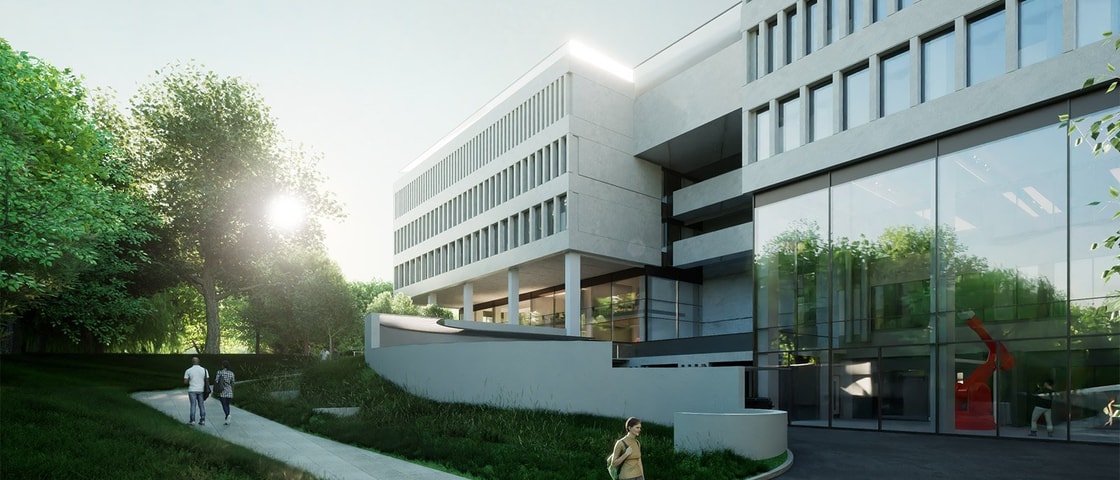
Working within the constraints of a Grade II listed building, the team retained the entire reinforced concrete structure and terrazzo stairwell flooring; preserving heritage while managing embodied carbon and reducing waste. Where upgrades were essential, such as glazing, low-U alternatives were installed to deliver an 85% improvement in thermal performance. This will save an estimated 30 tonnes of operational carbon annually.
The choice of materials used throughout the building was also aligned to this sustainable strategy. Concrete mixes incorporating cement replacements like Ground Granulated Blast Furnance Slag (GGBS) will cut embodied carbon by up to 57%. Meanwhile, lower emission steel and high-performance insulation further reduce the project’s carbon footprint. Extensive onsite reuse of materials, including timber, has already saved over 860 tonnes of CO₂e, with projected savings of 2,092 tonnes as the programme continues. Prefabricated modular systems, manufactured offsite and designed for future disassembly, ensure that the building remains adaptable for future occupant needs.
The outcome and what it means for the sector
This approach has delivered considerable environmental benefits. To date, the project has saved more than 860 tonnes of CO₂e, with further reductions expected as works progress. All non-hazardous construction waste has been diverted from landfill, tracked via live KPI dashboards, and 819 tonnes of recycled aggregates have been incorporated into the build.
Crucially, Lasdun Wall demonstrates that heritage can be an asset rather than an obstacle. Grade II status drove a circular approach that combines adaptability with deep carbon reductions. By retaining structure, upgrading the envelope, and specifying low carbon materials, the team has delivered a holistic decarbonisation strategy. Modular demountable systems reduce today’s waste and preserve tomorrow’s options. Circularity is more than a concept. It is a practical, scalable solution for public estates seeking to decarbonise at pace. This project is a blueprint for universities and public bodies aiming to meet climate targets without sacrificing the buildings that define them.
